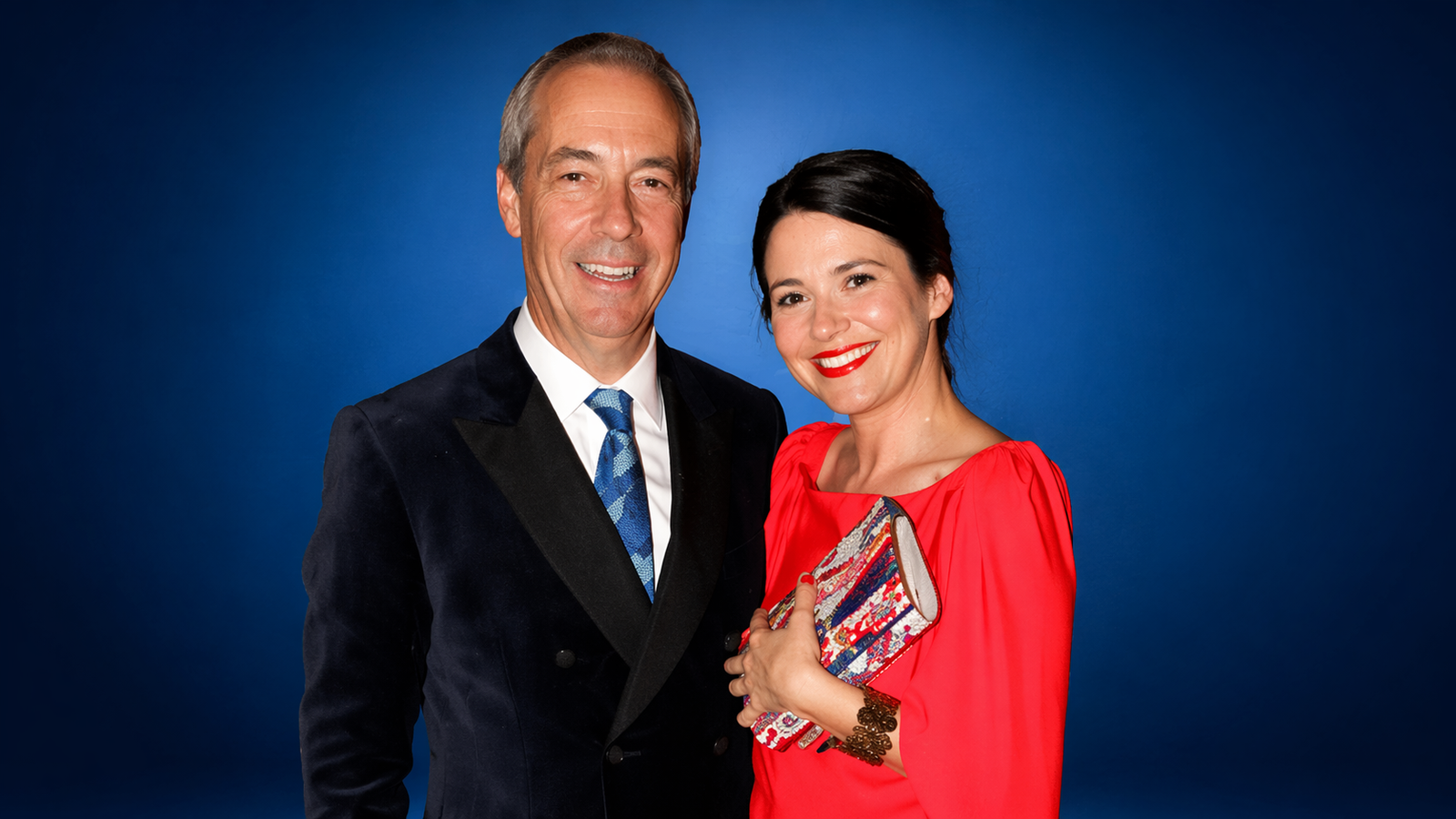
The public story of Gráinne Hayes begins not with ambition or fame, but with an accident. In 1985, a young London commodities trader named Nigel Farage was struck by a car and left seriously injured. During his recovery at Bromley Hospital, he met an Irish nurse who would quietly shape the next chapter of his life. That nurse was Gráinne Hayes. For most people, that brief connection would have faded into anonymity. Instead, it became the foundation of a marriage, a family, and a lasting, if largely private, place in the orbit of British public life.
Gráinne Hayes is not a public figure in the conventional sense. She has not sought the spotlight, built a media profile, or cultivated a public voice. Yet her name continues to surface, often tied to curiosity about Farage’s early life and personal relationships. That tension—between public interest and private reality—defines how her story is told. There is enough to understand her role in a significant political figure’s life, but not enough to construct the kind of detailed, fully documented biography often expected today.
Early Life and Irish Background
Reliable public information about Gráinne Hayes’s early life is limited, and that absence is itself revealing. What can be said with confidence is that she is Irish and trained as a nurse, a profession that suggests a structured education and a commitment to healthcare work that often goes unremarked in later retellings of her life.
There are no widely confirmed records detailing her hometown, family background, or early schooling. This is not unusual for someone who has not pursued a public-facing career. In many cases, such details remain part of private family history rather than public record. The internet, however, tends to blur that boundary, with some sources filling in gaps with unverified claims. A careful reading requires setting those aside and focusing on what can be supported.
What stands out is the path she chose. Nursing in the 1980s, particularly in the UK, was a demanding profession that required both technical training and emotional resilience. It placed Hayes in an environment where she would encounter patients in moments of vulnerability, including, as it turned out, the young man who would become her husband.
Meeting Nigel Farage
The most widely accepted account of Hayes’s introduction to Nigel Farage comes from Farage’s own recollections and subsequent reporting. After the 1985 accident that left him with serious injuries, he was admitted to Bromley Hospital. Hayes was part of the nursing staff involved in his care.
Their meeting is often described as the beginning of a relationship that grew during his recovery. While some retellings add romantic detail, the core facts remain simple. They met in a clinical setting, developed a connection, and stayed in contact after his discharge. Over time, that connection turned into a relationship that led to marriage.
Here’s where it gets interesting. This origin story has taken on a symbolic quality in later accounts of Farage’s life. It places Hayes at a formative moment, not just physically but emotionally, when Farage was recovering from a life-altering event. That context gives her presence a weight that extends beyond a typical first meeting, even if the details remain largely private.
Marriage and Family Life
Gráinne Hayes and Nigel Farage married in 1988, a few years after their initial meeting. At the time, Farage was building his career in the financial sector, working in commodities trading in London. The marriage coincided with a period before his full entry into politics, when his public identity was still forming.
The couple had two sons together, Samuel and Thomas. These details are among the most consistently reported aspects of Hayes’s life, appearing in mainstream coverage of Farage’s family. The boys were raised during a period when Farage’s political ambitions were beginning to take shape, adding a layer of complexity to family life that is often only hinted at in public accounts.
What’s striking is how little is known about Hayes’s role during these years beyond her identity as a wife and mother. There is no extensive public record of her career progression after marriage, though it is often assumed she continued in nursing for at least part of that period. Such assumptions, however, remain just that—assumptions—without clear documentation.
Family life during the late 1980s and early 1990s would have unfolded largely out of public view. Farage’s rise to political prominence came later, meaning Hayes experienced a version of his life that preceded the intense scrutiny that would follow. That distinction matters because it separates her experience from that of later partners who lived alongside his public career.
Divorce and Changing Circumstances
The marriage between Hayes and Farage ended in divorce in 1997. Like many aspects of their relationship, the reasons behind the separation have not been extensively detailed in public reporting. Farage has referred to the marriage in general terms in his memoir, describing it as a relationship that ultimately came to an end without offering a deeply personal account of the breakdown.
Divorce in this context marks a clear dividing line. After 1997, Hayes largely disappears from the public narrative, while Farage’s political trajectory accelerates. Within two years, he married his second wife, Kirsten Mehr, and continued his rise through the UK Independence Party and later Reform UK.
The timing is significant. Hayes’s departure from the public story coincides almost exactly with Farage’s transition into a more visible political role. That has shaped how she is remembered: not as a figure within his political life, but as part of his earlier, more private years.
Life Outside the Spotlight
After her divorce, Gráinne Hayes chose a path that has kept her firmly out of public view. There are no widely confirmed reports detailing her professional life, personal relationships, or current residence. This absence of information has led to speculation, but little of it can be reliably verified.
The truth is, many people connected to public figures make a conscious decision to step away from attention. Hayes appears to fall into that category. Rather than leveraging her connection to a prominent figure, she has maintained a level of privacy that is increasingly rare in the digital age.
Not many people know this, but maintaining privacy can require active effort, especially when a former partner becomes a high-profile political figure. It means declining interviews, avoiding public commentary, and keeping personal details out of easily searchable spaces. Hayes’s ability to remain largely private suggests a deliberate choice rather than an accident of circumstance.
Public Image and Media Portrayal
Gráinne Hayes does not have a traditional public image because she has not participated in public life in a visible way. Instead, her image is constructed indirectly, through references in articles about Nigel Farage. This creates a narrow and sometimes distorted view, shaped more by context than by her own actions or statements.
Media portrayals tend to be brief and factual, focusing on her role as Farage’s first wife and the mother of his two eldest children. There is little attempt to build a fuller portrait, partly because there is not enough material to support one. That restraint is appropriate, even if it leaves readers wanting more.
At the same time, the internet has produced a parallel stream of content that stretches beyond what is known. Some sites present detailed biographies with specific claims about her life after divorce, her finances, or her personal choices. Without strong sourcing, those claims remain questionable.
Here’s the reality. In the absence of direct interviews or confirmed records, the most accurate portrayal of Hayes is a limited one. She is known through her relationship to a public figure, and she has chosen not to expand that identity into a public persona of her own.
Financial Standing and Net Worth
There is no reliable, publicly confirmed estimate of Gráinne Hayes’s net worth. Any figures that appear online are speculative and should be treated with caution. Unlike public figures who disclose financial information or whose earnings can be tracked through visible careers, Hayes’s financial situation is private.
It is sometimes assumed that her divorce from Farage involved a financial settlement, as is typical in many divorces. However, the details of any such arrangement have not been made public. Without verified information, it is not possible to provide a meaningful estimate of her financial standing.
That said, her background as a nurse suggests a professional foundation that does not depend on public attention or media exposure. Nursing, while not associated with celebrity wealth, offers a stable career path that supports independence. Beyond that, any discussion of her finances moves into speculation.
Relationship to Nigel Farage’s Later Life
Gráinne Hayes’s connection to Nigel Farage remains a point of reference, even as his life has evolved in new directions. After their divorce, Farage went on to remarry and build a political career that has included leadership roles, media appearances, and continued influence in British politics.
Hayes, by contrast, has not been part of that public journey. She does not appear in coverage of his political activities, nor does she engage in commentary about his work. This separation reinforces the idea that her life after the marriage has been intentionally private.
What’s surprising is how enduring her presence is in search behavior. Even decades after the divorce, her name continues to appear in queries related to Farage. That persistence reflects the way public curiosity attaches itself to personal history, especially when it involves well-known figures.
Where Gráinne Hayes Is Now
There is no confirmed, up-to-date public information about where Gráinne Hayes lives or what she is doing today. This is one of the most common questions people ask, and it is also one of the hardest to answer with certainty.
Some online sources claim to know her current location or professional status, but these claims are not supported by widely recognized reporting. Without credible verification, they cannot be treated as reliable.
What can be said is that she has maintained her privacy over many years, even as interest in her former husband has risen and fallen. That consistency suggests a clear preference for a life outside the public eye, one that prioritizes personal boundaries over visibility.
Frequently Asked Questions
Who is Gráinne Hayes?
Gráinne Hayes is an Irish nurse best known as the first wife of British politician Nigel Farage. They married in 1988, had two sons, and divorced in 1997. Her public profile is limited, and most information about her comes through references in coverage of Farage’s life.
How did Gráinne Hayes meet Nigel Farage?
She met Nigel Farage while working as a nurse at Bromley Hospital after he was injured in a road accident in 1985. Their relationship developed during his recovery and continued after he left the hospital.
Do Gráinne Hayes and Nigel Farage have children?
Yes, they have two sons, Samuel and Thomas. These are the eldest of Farage’s four children, with his younger daughters born during his second marriage.
What is Gráinne Hayes’s profession?
She is known to have worked as a nurse, particularly at the time she met Farage. There is no widely confirmed public record detailing her career after her marriage or following her divorce.
What is Gráinne Hayes’s net worth?
There is no reliable public estimate of her net worth. Any figures found online are speculative and not supported by confirmed financial disclosures or credible reporting.
Where is Gráinne Hayes now?
Her current location and activities are not publicly confirmed. She has maintained a private life and does not appear to engage with media or public platforms.
Conclusion
Gráinne Hayes occupies a rare position in modern biography. She is known, but only partially. Her name appears in connection with a prominent figure, yet her own story remains largely her own. That balance between visibility and privacy defines how she is understood.
Her life intersects with a moment of public interest, but it does not depend on it. She represents a different kind of narrative, one where stepping away from attention becomes the defining choice. In a time when personal histories are often laid bare, that choice stands out.
The truth is, not every biography can be filled in with detail, and not every life is meant to be public. Gráinne Hayes’s story reminds us that absence of information is not a gap to be filled, but a boundary to be respected.
What remains is a clear outline: a nurse who met a future politician in a hospital ward, built a family, and then chose a quieter path. It is a modest story in some ways, but one that continues to draw interest precisely because of what it leaves unsaid.


